Please find below a number of pictures of the ceremony held at Passendale,
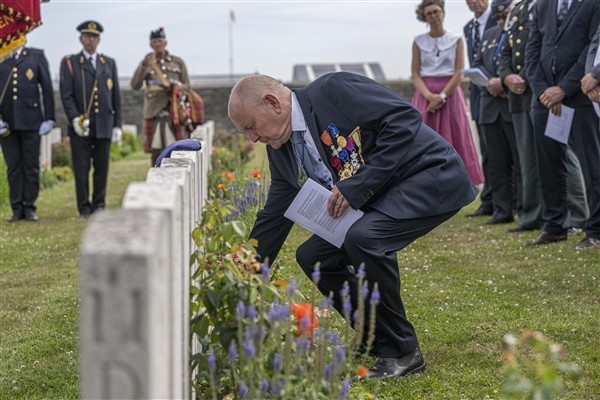
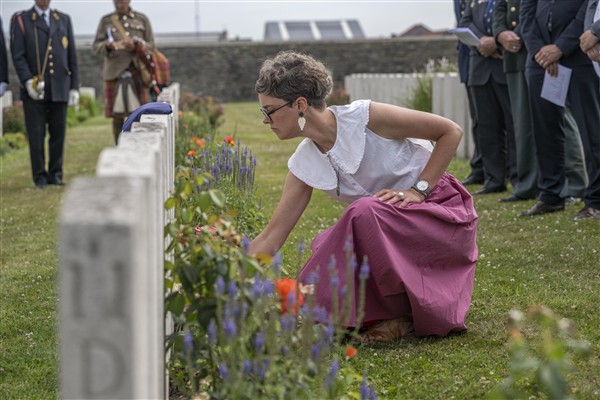
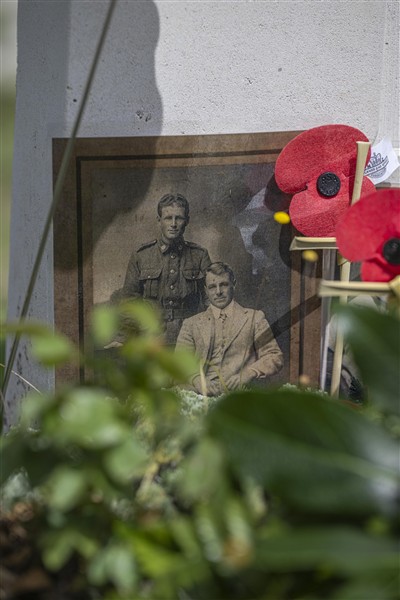
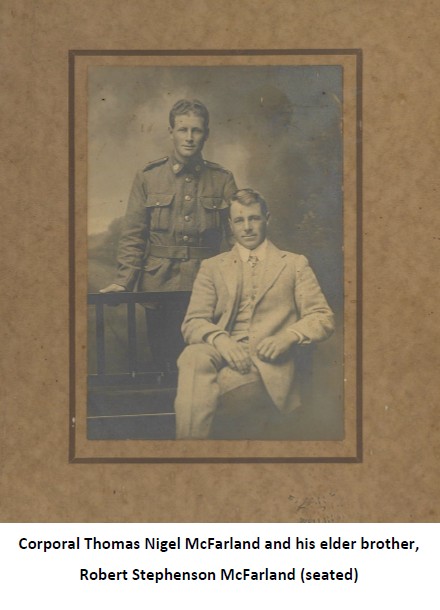
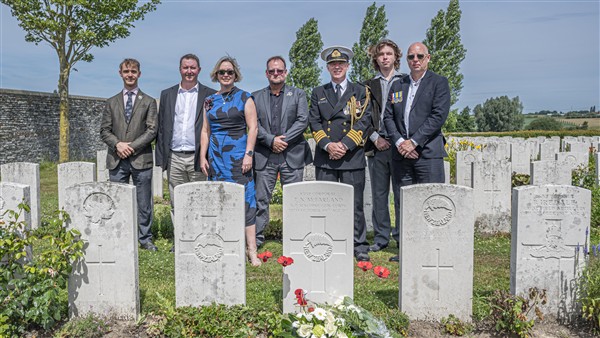
Passchendaele New British Cemetery, on Tuesday 7 July 2026. During this service Corporal Thomas Nigel McFarland, 1st New Zealand Machine Gun Company - Attached to 3rd New Zealand Rifle Brigade, got a new headstone with his name as research now has indicated that he had been buried there as an unknown soldier.
.jpg)
Killed in action during the Battle of Passchendaele on 12 October 1917, New Zealand’s Darkest Day.
.jpg)
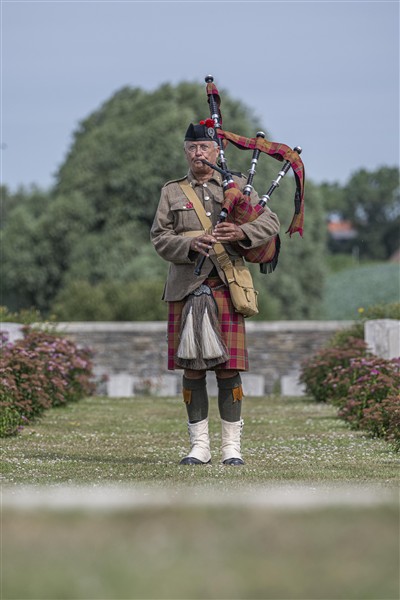
Captain James Barnes, MA, RNZN; New Zealand Defence Attache to Belgium.
.jpg)
Corporal McFarland – an insight into his Service and loss - Read by Captain James Barnes, MA, RNZN
Corporal Thomas Nigel McFarland died here at Passchendaele in Flanders. When he died, he was a member of the 1st New Zealand Machine Gun Company, part of the New Zealand Machine Gun Corps. Corporal McFarland enlisted on the 14th of August 1914, he joined the Otago Infantry Battalion as a Private. He was wounded at Gallipoli on the 12th of May 1915 but later returned to his Battalion. In 1916 he transferred to the Machine Gun Corps and was promoted to the rank of Corporal on 19 September 1917; he was killed just 23 days later on 12 October 1917 on the day known as New Zealand’s darkest day. He was aged 27.
The circumstances of his death are unclear. It is known that he did not die in the location of the machine guns, rather it appears he died in the vicinity of his Company headquarters and the headquarters of the 3rd New Zealand Rifle Brigade, to which his Company was attached. Close by was also an ammunition dump. Why was he here rather than at the guns? We will never know but there are many possible reasons; he may have been getting up to date orders from or providing location information to his company headquarters, collecting additional ammunition for the guns or simply held in reserve for the guns which were just a few hundred yards away. He may have been on his way to the frontline to man the guns and it is also possible, but less likely, that he was already mortally wounded and had been extracted from the front-line.
Unit War Diaries and J.H. Luxford’s With the Machine Gunners in France and Palestine indicate that 1st NZMG Coy suffered heavy casualties on 12 October. This Company spent four days and nights in the location that they first took up on the 12th of October 17. Captain Hayter, 1st NZMG Coy, sent a message that 52 other ranks were wounded and missing and 6 were killed in action. The October and November War Diaries do not contain any direct references to Corporal McFarland’s location during the battle of 12 October or reference his death. Nor do the Divisional Machine Gun Company Officer’s message book or Headquarters files for the 2nd New Zealand Infantry Brigade and 3rd New Zealand Rifle Brigade contain information regarding Corporal McFarland’s location or death.
According to orders issued on 9 October, 12 of 16 guns assigned to 1st NZMG Coy were allocated to C. Group, under the command of Captain Hayter. “Gun teams not used in the barrage will be kept close by to replace casualties and help with supply of ammunition.” C Group’s objective was to move forward to Furst Farm. On 12 October, 1st NZMG Coy moved forward and passed Korek at Zero plus 3 hours, at which point, the company was held up by machine gun fire. 1st NZMG Coy remained on the red line for the remainder of 12 October. Although the 1st NZMG Coy was located on the red line for the majority of the battle, Corporal McFarland was recovered behind the front line, on the road near Kansas Cross. Kansas Cross was a crossroads of activity during the Battle of Passchendaele. 1st NZMG Coy Headquarters was at Kansas Cross on 11 and 13 October, but moved forward to Korek in the early stages of the battle on 12 October, returning sometime before 5:30pm, where a “barrage was prepared and a telephonic communication from HQ 2nd Brigade confirmed M.G. barrage on RED LINE.” Captain Hayter noted that he and Captain Chayter (5th NZMG Coy) were at Kansas House and that Captain Caws (3rd NZMG Coy) “was only 3 or 4 hundred yards away.” This demonstrates that personnel from several New Zealand Machine Gun Companies are present around Kansas House at this time. According to the CWGC, Corporal McFarland was recovered “just a few hundred yards away” from Kansas House. The road on which Corporal McFarland was recovered also ran between 1st NZMG Coy Headquarters at Kansas Cross and 3rd New Zealand Rifle Brigade Headquarters at Gallipoli.
However, one handwritten entry in the 1st NZMG Coy Routine Orders book shows a list of Promotions dated 10 October 1917 and reads “8/252 Corporal McFarland to be acting Sergeant.” The entry is crossed out but no reason is given. This promotion is not recorded in McFarland’s Personnel file. My suspicion is that the entry was crossed out after the news of his death.
This confused narrative gives an insight into Siegfried Sassoon’s famous poem, Memorial Tablet which says “I died in hell – (They called it Passchendaele).”
A total of 1796 New Zealand soldiers died during the Passchendaele offensive in 1917. The vast majority were killed on 12 October 1917, during the Battle of Passchendaele, a day remembered as New Zealand’s “Darkest Day” when up to 846 young men were killed in a matter of hours.
Corporal Thomas Nigel McFarland was one of these men.
.jpg)
.jpg)
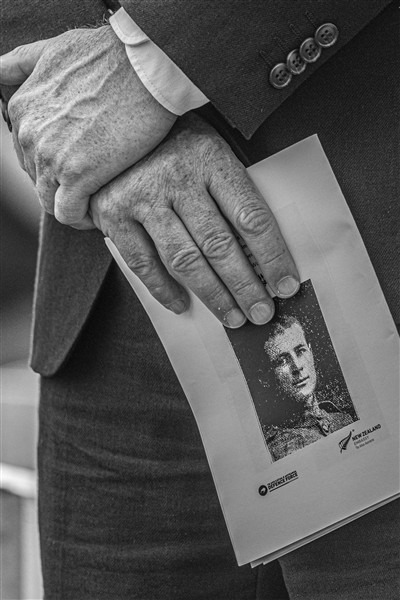
Her Excellency Jennifer Troup, Ambassador of New Zealand to Belgium
.jpg)
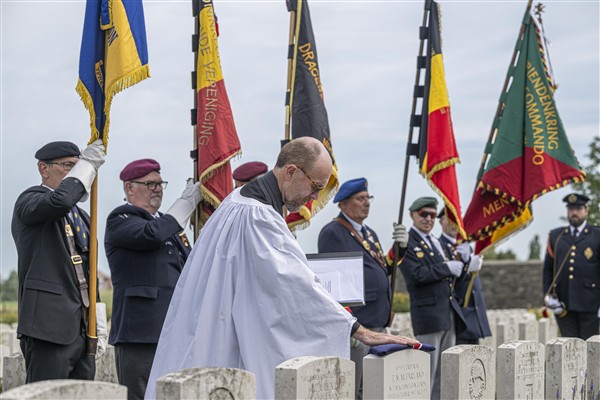
Prayer and Blessing of the Headstone – Reverend Richard Clement
.jpg)
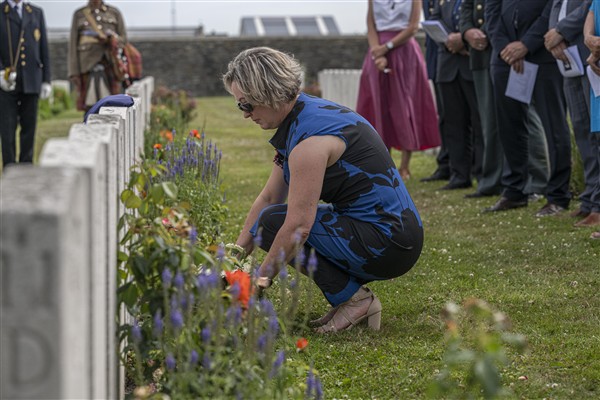
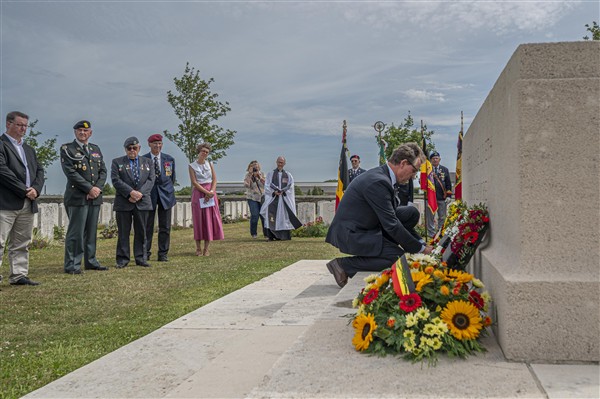
Placing of flowers at the Headstone
.jpg)
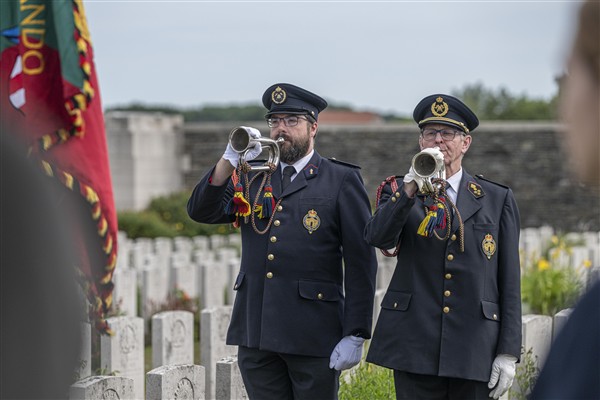
The Last Post
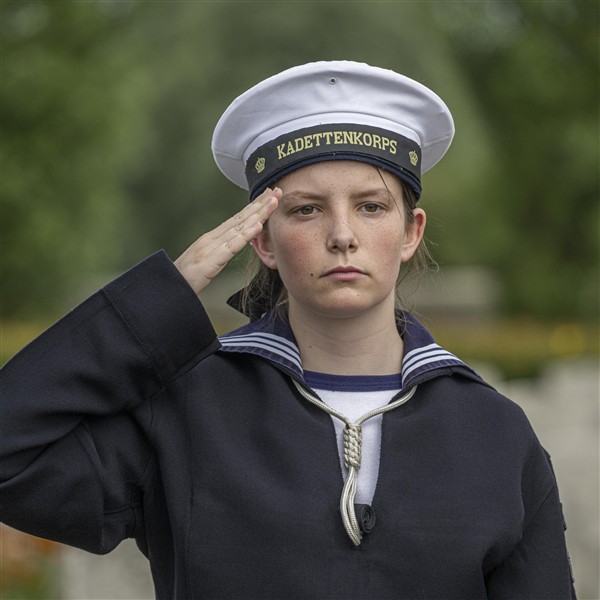
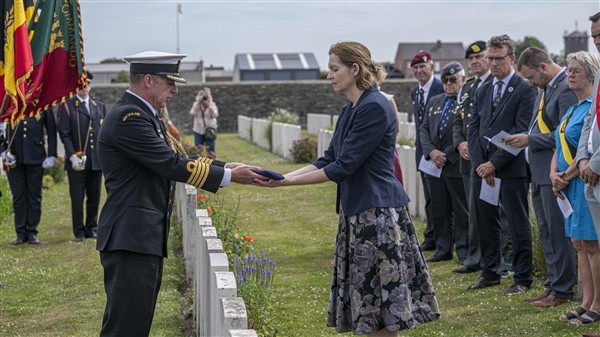
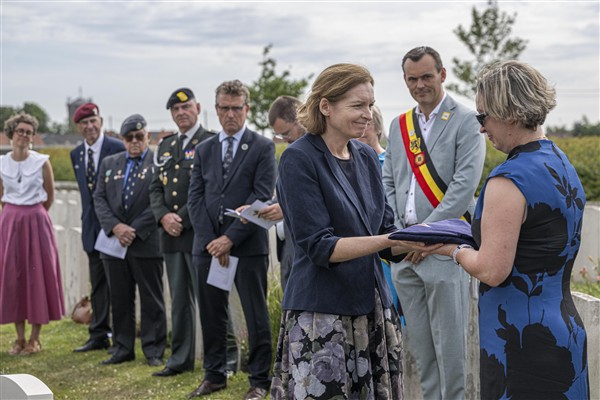
Presentation of the New Zealand Flag to the McFarland Family.
.jpg)
.jpg)
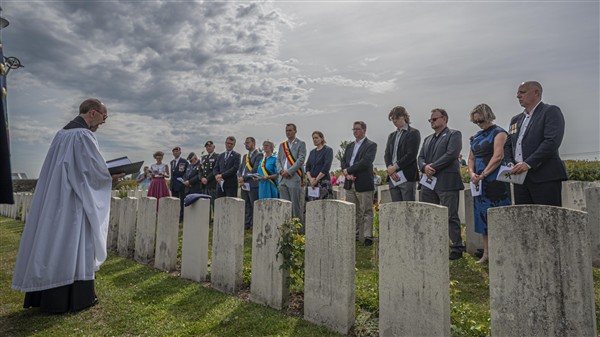
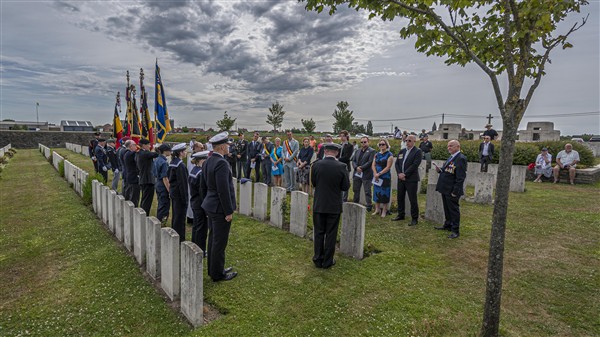
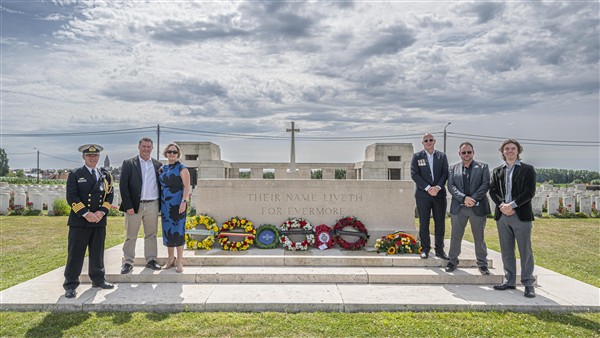
Family and official party move to the War Stone for the laying of wreaths
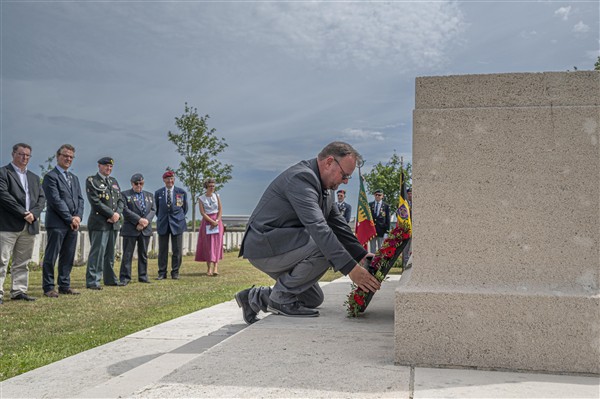
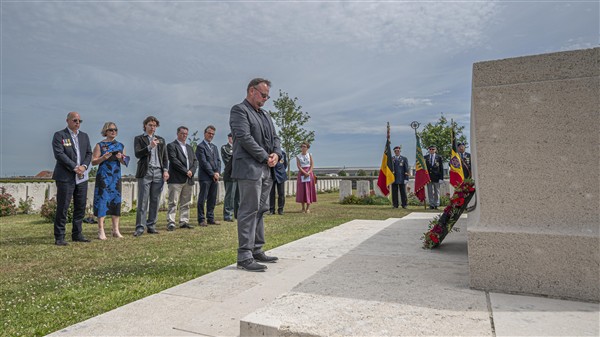
.jpg)
.jpg)
.jpg)
.jpg)
.jpg)
.jpg)
.jpg)
Page made by WO1.be / Greatwar.be - Foto's/Pictures Eric Compernolle.