26/09/2026
- Ploegsteert
- Source: CWGC
On 24 September 2026, Comines-Warneton and the
Commonwealth War Graves Commission (CWGC) unveiled the UNESCO plaques on CWGC First World War Memory sites.
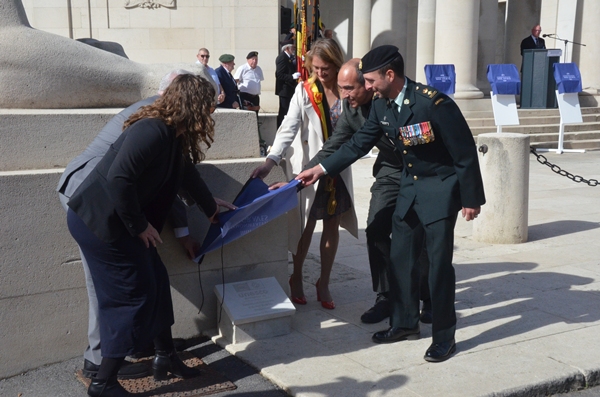
The Town of Comines-Warneton and the Commonwealth War Graves Commission (CWGC) today unveiled, at the Ploegsteert Memorial, in the presence of numerous political and diplomatic dignitaries and schoolchildren from the municipality, the plaques for eight CWGC sites on the Western Front that were inscribed on the UNESCO World Heritage List in September 2023.
The inscription of 139 First World War memorial sites by UNESCO: a symbol of peace for the future
.JPG)
The inscription is part of a wider initiative to inscribe Funeral & Memorial Sites of The First World War (Western Front) with UNESCO World Heritage Status. The proposal was sponsored by the Belgian (Flanders and Wallonia) and French states, and in total includes 139 locations connected with WW1.
By recognising the outstanding universal value of these memorial sites, which commemorate the sacrifice of people from many nations and faiths, the nomination acknowledges the CWGC’s century-long stewardship of all the cemeteries and memorials. World Heritage status also recognises the global significance of these ‘silent cities’ for the commemoration of the war deads and helps to attract a wider and more diverse audience.
8 CWGC UNESCO sites located in the municipality of Comines-Warneton
The eight Commonwealth War Graves Commission memorial sites in Comines-Warneton, listed as World Heritage Sites, are as follows:
the Ploegsteert Memorial and Berks Cemetery Extension, as well as seven CWGC military cemeteries:
Hyde Park Corner,
Strand Military Cemetery,
Mud Corner Cemetery,
Prowse Point Military Cemetery,
Toronto Avenue Cemetery,
Ploegsteert Wood Military Cemetery and
Rifle House Cemetery.
Every CWGC site has its own character, history and human stories. Whether through names carved in stone, graves cared for in perpetuity, or memorials to those with no known grave, each place speaks to the individual lives lost and to the enduring responsibility we share to remember them.
A World Heritage Site shared with future generations
During the ceremony, the Commonwealth War Graves Commission lit its torch for peace. As the years pass, the responsibility of sharing the stories of those who fought and died here passes to others. And keep those stories alive we must.
We wanted to inspire a new generation to understand the importance of what these people did, and why we must remember them. Therefore, in Comines-Warneton, Belgium, the public could see the lighting of a torch - a Torch for Peace.
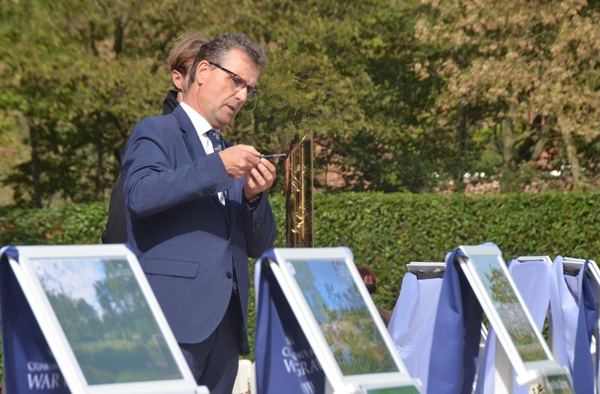
The inspiration for this torch came from several sources - including the First World War poem, In Flanders Fields, written by Canadian army doctor and poet, John McCrae.
During the ceremony, Ms Alice Leeuwerck, Mayor of Comines-Warneton, said: “
Whilst our daily lives are, with the passing of time, becoming increasingly distant from those of our forebears who lived through 1914-18, the rumblings of war now echoing at Europe’s doorstep remind us that war once passed right past our doorstep. That young men from faraway lands lost their lives here to prevent the law of the strongest from prevailing. That our great-grandparents or grandparents endured this maelstrom of unprecedented violence, of which we have no idea, and of which we have lost all sense. Now oases of peace, these sites where thousands of soldiers-victims of the clash between the grand sweep of history and their individual destinies-rest, undoubtedly constitute the most powerful plea against war that one could imagine. It is for this reason that I particularly welcome the presence of children at this ceremony.”
Mr Yves Rouyet, Chair of the Belgian Francophone and German-speaking Commission for UNESCO, declared: “
UNESCO is not a ‘super-label’ for heritage. Rather than simply seeking to save world heritage or exceptional monuments, it was established under the auspices of the United Nations to promote understanding between peoples and peace through education, science, culture and communication. One of UNESCO’s aims is to build multilateralism through international cooperation and to create a collective capacity to move forward. In this respect, the process of collaboration between partners from different cultures that precedes inscription on the World Heritage List is almost as important as the recognition itself.”
For the CWGC, Mr Xavier Puppinck, Central & Southern Europe Area Director, said: “
Today, we are unveiling these UNESCO plaques and recognising the eight CWGC sites in Comines-Warneton as part of a wider landscape of remembrance on the former Western Front, inscribed by UNESCO as a World Heritage Site. These plaques remind us that remembrance is not static. It is something we actively uphold - through our presence, through education and understanding, and through the care that the CWGC continues to provide for these sites. We also renew our promise: that those commemorated here - and the millions of people they represent - will never be forgotten.”